Internal Linking & Site Navigation Improve SEO Signals and User Journeys

Internal linking often gets brushed aside in SEO conversations, as if it’s just about connecting pages here and there. In reality, it’s one of the few levers you fully control that can directly influence how your site performs in search, how easily users find what they’re looking for, and how efficiently your most important pages convert traffic into results.
Think of your website like a city. Internal links are the roads and signs. If those roads are broken, confusing, or poorly placed, people get lost, take wrong turns, or never reach the destinations that matter; like your contact form, product page, or high-value blog post. If the roads are well built and well marked, people move with confidence, and Google follows them too.
Below is a breakdown of why internal linking is so powerful, what common mistakes are holding back your performance, and what best practices your SEO team should be applying to make every page work harder for your business.
What Internal Linking Really Does (and Why Google Loves It)
Internal linking isn’t just about helping users get from page to page, it’s a critical signal that tells Google how your website is organized, which pages matter most, and what topics your site covers in depth.
When search engines crawl your website, they follow internal links to discover new content. These links help Google understand the relationships between your pages and the overall structure of your site. Strong internal linking helps ensure that your most valuable pages are not only found but also prioritized in search rankings.
Here’s what internal links achieve for SEO:
- Page discovery: Internal links help search engines find deeper pages that may not be directly linked from your homepage.
- Page importance: Linking frequently to a page tells Google it’s important. This is how internal linking distributes link equity across your site.
- Topical relevance: Links between related content help reinforce the themes and topics your site wants to rank for.
Simply put, if your internal linking strategy is weak, your content may be invisible to search engines and underperforming in rankings, even if it’s well written. Fin out what actually works in SEO today.
The Business Role: Internal Links That Drive Conversions
Good internal linking isn’t just about SEO rankings—it’s about guiding users toward your most profitable pages and turning visits into results. Every internal link is an opportunity to shape the customer journey, reduce drop-offs, and increase conversion rates.
Whether you’re promoting a service, selling a product, or generating leads, internal links help direct attention to high-value areas of your site. Think of them as nudges that help users explore your offerings naturally, without needing to return to the menu or start from the homepage.
Key ways internal linking supports conversions:
- Increased visibility of revenue-generating pages: Linking from blog posts or informational pages to sales or booking pages improves discoverability and conversion potential.
- Better engagement paths: Thoughtful internal linking keeps users on your site longer, exposing them to more content and offers.
- Improved performance of underutilized content: Strategic linking can bring traffic to older but still relevant pages that support your goals.
If your site has great content but underwhelming performance, weak internal linking is often the silent culprit. You can’t convert users who never find your most important pages.
Common Internal Linking Mistakes (That Cost You Rankings)
Not all internal links are created equal. In fact, many websites unintentionally weaken their SEO performance with poor linking decisions. If your internal link structure is sending confusing or inconsistent signals to search engines, you’re likely leaving rankings (and revenue) on the table.
Here’s what that looks like in practice:
- Over-relying on navigation links
Only using menus and footers to link between pages misses huge opportunities. Google values links embedded within the body of your content because they appear more contextual and natural. - Using vague or generic anchor text
Links that say “click here” or “learn more” tell users and search engines nothing about what’s on the next page. Descriptive anchor text boosts relevance and clarity. - Linking to everything from everywhere
When every page links to every other page, nothing stands out. Important pages should receive more internal links than low-priority ones—this is how you signal page importance to Google. - Forgetting about orphan pages
Pages with no inbound internal links are essentially invisible. If a page doesn’t get linked, Google may never find it, and users certainly won’t. - Not optimizing internal links for mobile
Poorly placed or hard-to-tap links on mobile devices hurt usability, especially on pages with long-form content.
Spotting and fixing these common internal linking issues can give your SEO strategy a fast, noticeable lift—without needing new content or backlinks.
What Effective Internal Linking Looks Like
A strong internal linking strategy isn’t just about quantity—it’s about clarity, intent, and structure. When links are planned with purpose, they support both users and search engines by reinforcing topic relevance and distributing authority across your site.
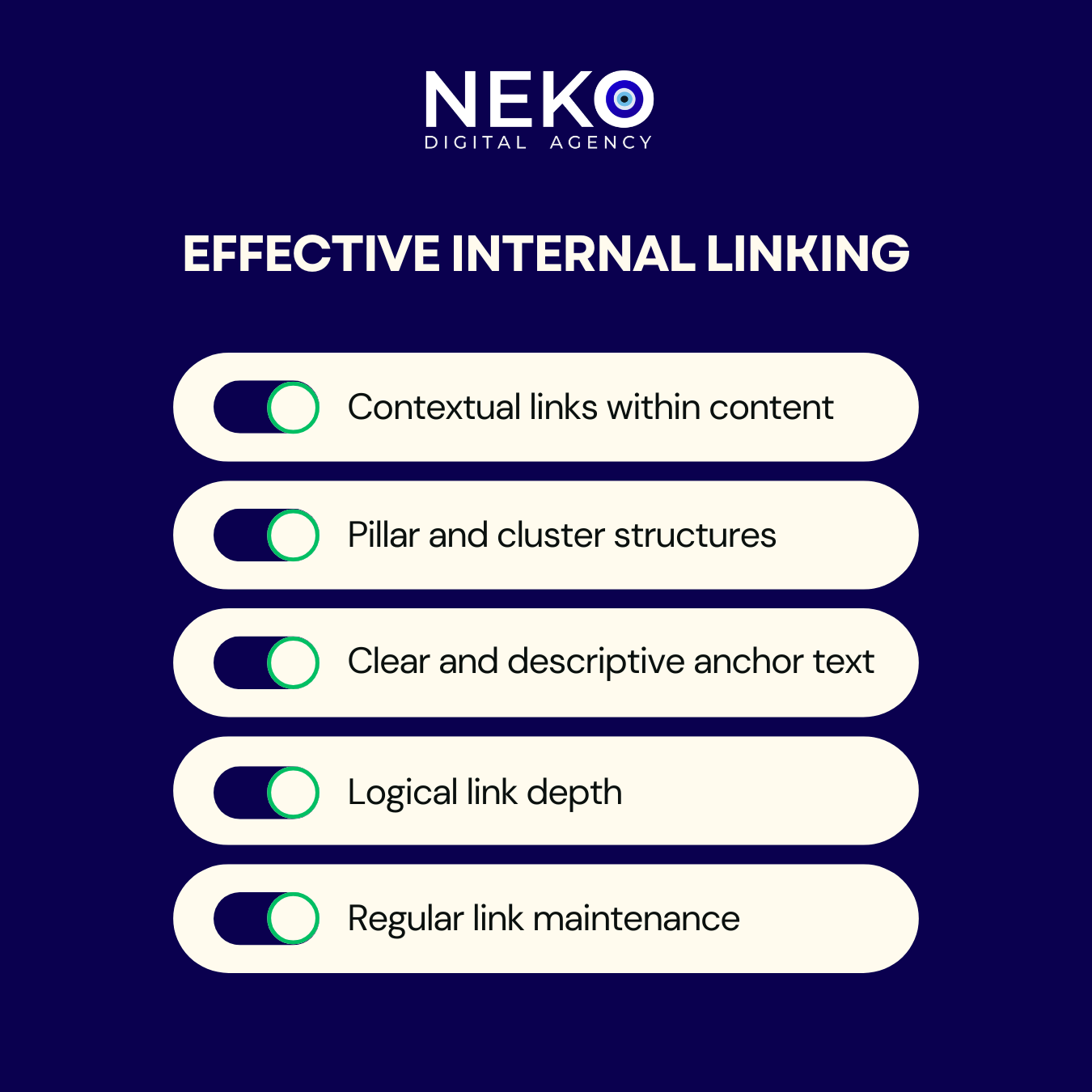
Here are the core elements that define effective internal linking:
- Contextual links within content: These are embedded naturally in articles or product pages, guiding users to related information and keeping them engaged. Google gives more weight to in-content links than those in navigation bars or footers.
- Pillar and cluster structures: This method organizes your site into main hub pages (pillars) surrounded by detailed subtopics (clusters), all linked together. It strengthens thematic relevance and improves crawlability.
- Clear and descriptive anchor text: Your anchor text should describe what the linked page is about. For example, linking with “how to improve page speed” is more effective than “read more.”
- Logical link depth: Important pages should be reachable within three clicks from the homepage. If something takes too many steps to find, users (and Google) are less likely to reach it.
- Regular link maintenance: Broken or outdated internal links damage user experience and crawl efficiency. A quarterly internal link audit helps maintain site health and performance.
When these best practices are in place, internal links become more than navigational aids—they become strategic SEO assets that drive both discovery and conversions.
Tools to Monitor and Improve Internal Linking
Even the best internal linking strategy needs oversight. Regular audits help you catch issues early, track performance, and refine your approach. The good news is, you don’t need to guess. There are reliable tools that reveal exactly how your internal link structure is working—and where it’s falling short.
Recommended tools and what they show:
- Screaming Frog SEO Spider: This desktop crawler gives a complete map of your internal links. You can identify broken links, orphan pages, and see which pages have too few or too many inbound links. It’s ideal for spotting crawl bottlenecks and optimizing link flow.
- Google Search Console (GSC): Under the “Links” section, GSC lists your most linked pages internally. It’s a simple way to verify whether your top-performing content is receiving enough internal support.
- Manual review: Sometimes a quick walkthrough of your key pages can uncover usability issues that data alone won’t catch. Ask: is the next logical step obvious? Are important links being missed or buried?
These tools help ensure that your internal linking remains strategic, functional, and aligned with your business goals. Reviewing link performance every few months can prevent silent issues from building up and costing you rankings or conversions. If you don’t have time to get into such detail, here’s out take on how business owners or marketing directors should measure SEO performance.
Business Wins From Smarter Internal Linking
At its core, internal linking is about efficiency—helping users and search engines reach your highest-value content faster. When done well, it doesn’t just improve rankings—it drives real business impact.
Here’s what a smarter internal linking strategy can unlock for your business:
- Higher conversion rates: Clear and strategic links guide users through your funnel. Blog readers become product viewers, then buyers. Service pages lead to contact forms. Each link supports a step in the user journey.
- Improved organic performance: Google rewards well-structured sites. When internal links highlight the importance of certain pages, those pages tend to rank better—especially for competitive keywords tied to revenue.
- Better content utilization: Many businesses invest in content that gets buried over time. Smart internal linking revives older assets and keeps them driving value long after publication.
- Reduced bounce rates and higher engagement: Links that make sense and match user intent keep people on your site longer. That sends strong quality signals to search engines.
These aren’t small wins. For businesses that rely on search traffic, a well-planned internal linking strategy can mean the difference between plateauing and scaling.
Final Thoughts: Internal Links Are Your Hidden Growth Engine
Internal linking isn’t just a technical detail—it’s a core part of your SEO strategy. It shapes how search engines understand your site, how users move through it, and how effectively you turn traffic into results.
If you’ve invested in content, design, or traffic acquisition but still feel underwhelmed by performance, take a closer look at your internal link structure. Often, the fastest path to growth is already on your website—it just needs better connections.

Myles Dalmain-Jones
With more than 10 years of experience in Marketing, Online Lead Gen & Business Growth, I provide custom strategies for online business growth by analyzing the market, the latest trends and most importantly, staying up to date with what tactics are providing success to similar products or brands. I've had enough B2B and B2C experience but I simply love digging deep and trying to improve my value. I love to talk about online growth, get in touch if you have any comments on my contents.
Get in touch
How can Neko Digital Agency help you?
Our years of experience as a Digital Marketing Agency result in specific expert knowledge on diverse industries. Don’t risk yourself generating content without knowing whether it will improve the ranking of your webpage. Obtain real and fast results with Neko Digital Agency. Contact us without commitment and we will study your case.