
The Ultimate Guide to Conversion Rate Optimization for eCommerce Owners
Most eCommerce businesses focus heavily on driving traffic: running ads, improving SEO, and engaging on social media. But what happens once visitors land on your website? If they aren’t converting into paying customers, all that traffic is just wasted potential.
This is where Conversion Rate Optimization (CRO) comes in. CRO is the art and science of turning website visitors into buyers by refining design, user experience, and functionality. Even a 1% increase in conversion rate can mean thousands of dollars in extra revenue every month.
Yet many eCommerce store owners struggle with slow-loading pages, complicated checkout processes, and ineffective calls-to-action, all of which silently kill conversions. Worse, they don’t realize that small, strategic improvements could dramatically boost sales without increasing ad spend.
Read this complete guide to learn expert insights and proven strategies to help you optimize your store for maximum conversions. You’ll learn what slows down sales, how to fix it, and real-world tactics used by successful brands. By the end, you’ll have a clear roadmap for turning more visitors into loyal customers without spending more on traffic.
Table of Contents
First, Understand Conversion Rate Optimization (CRO)
Every eCommerce business wants more sales, but increasing website traffic alone isn’t the answer. Conversion Rate Optimization (CRO) is the key to turning visitors into paying customers without spending more on ads.
Instead of focusing solely on bringing more users to your store, CRO ensures that your existing traffic is working harder for you. Even small improvements in conversion rates can drastically boost revenue, making CRO one of the highest-ROI strategies for any online store.
What is CRO and Why is it Critical?
Conversion Rate Optimization (CRO) is the process of improving your website to increase the percentage of visitors who take a desired action – whether that’s making a purchase, signing up for a newsletter, or adding items to their cart.
Why CRO is a Game-Changer for eCommerce
- More Sales Without More Traffic: Instead of spending more on ads, CRO ensures that your existing visitors convert at a higher rate.
- Lower Customer Acquisition Cost (CAC): The higher your conversion rate, the more revenue you generate from each visitor—reducing the cost per sale.
- Better User Experience = Higher Trust: Customers buy from stores that feel professional, easy to use, and credible. A well-optimized site builds trust and increases retention.
Key Metrics Every eCommerce Business Should Track
CRO isn’t about guessing; it’s a data-driven process. To optimize effectively, you need to track the right performance metrics:
- Conversion Rate (CR): Percentage of visitors who complete a purchase.
- Bounce Rate: Percentage of users who leave without interacting.
- Average Order Value (AOV): The average amount spent per transaction.
- Cart Abandonment Rate: Percentage of users who add items to their cart but don’t complete the purchase.
By tracking these key performance indicators, you can pinpoint where you’re losing potential customers and make **data-backed improvements** that drive higher conversions.
Next, we’ll dive into the biggest eCommerce conversion killers, and how to fix them.
The Biggest eCommerce Conversion Killers (And How to Fix Them)
Even the best marketing campaigns won’t generate revenue if your eCommerce site pushes visitors away due to poor design, slow performance, or a frustrating shopping experience.
Instead of covering general website issues (which we discussed in our guide on website optimization for better Google Ads performance), this section focuses on eCommerce-specific conversion killers, problems that directly impact online sales and how to fix them.
Poorly Optimized Product Pages
- Low-quality images & lack of video: Shoppers can’t see details clearly, reducing trust.
- Unclear product descriptions: Too short or generic descriptions fail to highlight benefits.
- No urgency or scarcity: If there’s no reason to buy now, shoppers delay their purchase.
How to Fix It
✔ Use high-quality images & 360° product views: Show products from all angles, with zoom-in features.
✔ Write persuasive, benefit-driven descriptions: Highlight how the product solves a problem or improves the buyer’s life.
✔ Add urgency & scarcity triggers: Limited stock messages (“Only 3 left!”) and countdown timers boost conversions.
Friction in the Checkout Process
- Forcing account creation: 34% of users abandon checkout if they must create an account.
- Complicated forms: Too many fields create friction.
- Hidden shipping costs: Unexpected fees at checkout lead to drop-offs.
How to Fix It
✔ Enable guest checkout: Let users buy without signing up.
✔ Reduce form fields: Only ask for essential information.
✔ Show shipping costs early: Include shipping calculators on product pages.
Lack of Personalization & AI-Driven Recommendations
- No dynamic product recommendations: Users leave without discovering relevant products.
- One-size-fits-all marketing: Generic emails and promotions don’t engage customers.
How to Fix It
✔ Show AI-powered product recommendations: Display “You May Also Like” or “Frequently Bought Together” suggestions.
✔ Enable personalized email marketing: Send tailored promotions based on browsing & purchase history.
Next, we’ll explore the most effective strategies to maximize conversions and revenue.
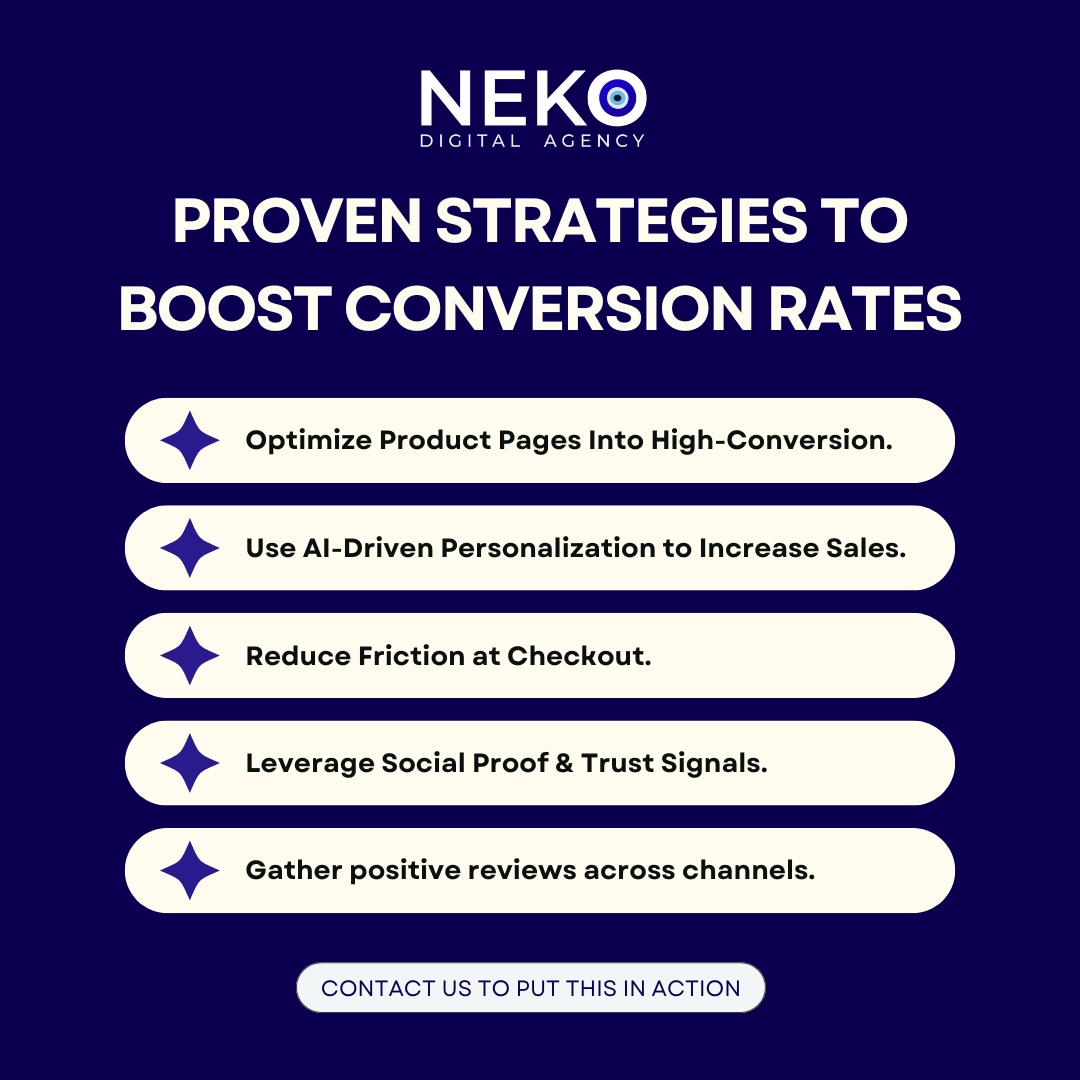
Proven Strategies to Boost Conversion Rates
Now that we’ve identified the biggest eCommerce-specific conversion killers, it’s time to focus on proven strategies that can maximize sales, improve user experience, and ensure that more visitors become paying customers.
We’re diving into advanced eCommerce tactics, from product page optimizations to AI-driven personalization and behavioural targeting.
Turn Product Pages Into High-Converting Sales Machines
💡 Fact: 87% of online shoppers say product content is critical in their purchase decision.
Your product page is where the buying decision happens. If it doesn’t grab attention, build trust, and create urgency, potential customers will leave without purchasing.
How to Fix It
✔ Use high-quality images & 360° product views: Show products from all angles, with zoom-in features.
✔ Write persuasive, benefit-driven descriptions: Highlight how the product solves a problem or improves the buyer’s life.
✔ Add urgency & scarcity triggers: Limited stock messages (“Only 3 left!”) and countdown timers boost conversions.
💡 Example: A fashion eCommerce store increased conversions by 22% after replacing static product images with short lifestyle videos showcasing how their clothes fit and move.
Use AI-Driven Personalization to Increase Sales
💡 Fact: AI-powered product recommendations can increase conversions by 20-30%.
Customers expect personalized experiences—generic product suggestions or irrelevant promotions won’t engage them.
How to Fix It
✔ Show dynamic product recommendations: Use AI to display “You May Also Like” or “Frequently Bought Together” suggestions.
✔ Use personalized email marketing: Send tailored recommendations based on past purchases and browsing behavior.
✔ Enable recently viewed product sections: Let users quickly return to items they were interested in.
💡 Example: A beauty brand increased repeat purchases by 38% after implementing AI-driven email recommendations based on previous customer interactions.
Reduce Cart Abandonment With Frictionless Checkout
💡 Fact: 69.8% of shopping carts are abandoned.
Even if customers want to buy, frustrating checkout experiences can drive them away.
How to Fix It
✔ Enable guest checkout: Don’t force customers to create an account before purchasing.
✔ Remove unnecessary checkout fields: Only ask for essential information.
✔ Offer multiple payment options: Accept PayPal, Apple Pay, Google Pay, and Buy-Now-Pay-Later services like Klarna or Afterpay.
💡 Example: A DTC electronics brand recovered 15% of abandoned carts by using a 3-step checkout process and real-time cart reminders via email and SMS.
Leverage Social Proof & Trust Signals to Boost Conversions
💡 Fact: 92% of consumers trust peer reviews over brand marketing.
Customers hesitate to buy from new stores—building trust is key.
How to Fix It
✔ Showcase customer reviews & ratings: Place them above the fold on product pages.
✔ Feature influencer & expert endorsements: If a well-known figure endorses your product, highlight it.
✔ Use trust badges (SSL, secure payments, money-back guarantee): Reassure users at checkout.
💡 Example: An outdoor gear store increased conversions by 19% after adding customer video reviews showcasing real buyers using their products.
Next, we’ll look at data-driven techniques to take your CRO strategy even further.
Data-Driven Approaches to eCommerce CRO
Unlike basic website optimization, eCommerce conversion rate optimization (CRO) requires a data-driven approach. Instead of guessing what works, successful brands rely on A/B testing, behavioral tracking, and AI-powered insights to refine the customer experience continuously.
A/B Testing: The Secret to Continuous Growth
💡 Fact: A/B testing can increase conversion rates by up to 30% when done consistently.
A/B testing compares two versions of a webpage, product description, or checkout process to see which one converts better.
How to Fix It
✔ Test product page layouts: Do larger images or more detailed descriptions lead to more purchases?
✔ Experiment with CTA buttons: Does “Buy Now” perform better than “Get Yours Today”?
✔ Optimize checkout flow: Does a one-page checkout outperform a multi-step process?
💡 Example: A clothing brand increased sales by 18% after A/B testing CTA colors and placement—moving the “Add to Cart” button higher on the page.
Using Heatmaps & Behavioral Analytics to Find Drop-Off Points
💡 Fact: 67% of users don’t scroll past the first screen of a webpage.
Heatmaps visualize user behavior, showing where shoppers click, scroll, or drop off before making a purchase.
How to Fix It
✔ Identify dead zones: If users ignore key product information, reposition it higher.
✔ Improve CTA placement: If users don’t click “Add to Cart”, move it to a more visible area.
✔ Optimize checkout flow: If drop-offs occur mid-checkout, streamline the form.
💡 Example: An online electronics store increased conversions by 22% after discovering users ignored their “10% Off” promo banner because it was placed too far down the page. They moved it above the fold, leading to higher engagement.
AI-Powered Personalization for Higher Conversions
💡 Fact: AI-driven recommendations increase conversions by 20-30%.
Today’s shoppers expect a tailored experience—they want to see products relevant to their interests and behavior. AI makes this possible by analyzing browsing history, past purchases, and real-time intent.
How to Fix It
✔ Show personalized product recommendations: Display “You May Also Like” and “Frequently Bought Together” items.
✔ Use dynamic pricing: Offer discounts based on user behavior (e.g., first-time buyers get 10% off).
✔ Enable AI-powered chatbots: Assist customers in real-time by recommending products based on their preferences.
💡 Example: A beauty brand increased repeat purchases by 42% after implementing AI-driven product recommendations on product pages and in abandoned cart emails.
Retargeting & Behavioral Segmentation for Higher Repeat Sales
💡 Fact: It costs 5x more to acquire a new customer than to retain an existing one.
Many eCommerce brands focus too much on acquiring new traffic but fail to re-engage previous visitors and customers. Retargeting helps bring them back and increase lifetime value (LTV).
How to Fix It
✔ Run dynamic retargeting ads: Show personalized ads on social media & Google ads featuring items users viewed but didn’t buy.
✔ Segment audiences for targeted email campaigns: Offer exclusive discounts to past customers who haven’t purchased in a while.
✔ Use browse abandonment emails: Remind visitors about products they checked out but didn’t add to their cart.
💡 Example: An outdoor gear retailer increased repeat purchases by 28% using retargeting ads featuring customer-specific product recommendations.
Professional Checklist for eCommerce CRO Success
Conversion Rate Optimization (CRO) isn’t about one big change, it’s about continuous improvements that make your website faster, easier to use, and more persuasive. To ensure your store is fully optimized, we’ve compiled the ultimate CRO checklist based on proven strategies.
By following this checklist, you’ll systematically remove friction points, increase trust, and maximize the percentage of visitors who turn into paying customers.
I’ve created this actionable e-commerce CRO checklist in Google Sheets for you to make a copy and use it.
Website Performance & User Experience
✔ Site speed is under 2 seconds: Use Google PageSpeed Insights to check loading times.
✔ Mobile-first design: Ensure smooth navigation and fast load times on smartphones.
✔ Clear, intuitive navigation: Visitors should find what they need in 3 clicks or less.
✔ No clutter or distractions: Keep pages clean with a clear focus on conversions.
High-Converting Product Pages
✔ High-quality images & videos: Use multiple angles, zoom-in views, and lifestyle shots.
✔ Persuasive product descriptions: Focus on benefits, not just features.
✔ Urgency & scarcity triggers: Use “Only X left in stock” or time-sensitive discounts.
✔ Clear pricing and no hidden fees: Customers should know exactly what they’ll pay.
Calls-to-Action (CTAs) That Convert
✔ CTA buttons are large and visible: Use contrasting colors for “Add to Cart” and “Checkout” buttons.
✔ Action-oriented CTA text: “Get Yours Today” converts better than “Learn More”.
✔ CTAs are placed in high-visibility areas: Above the fold and near product descriptions.
✔ A/B testing different CTA styles: Test colors, text, and placement to find what works best.
Checkout Optimization to Reduce Abandonment
✔ Guest checkout enabled: Don’t force users to create an account before buying.
✔ Fewer form fields = higher conversions: Only ask for essential information.
✔ Multiple payment options: Offer credit card, PayPal, Apple Pay, Google Pay, and BNPL (Buy Now, Pay Later) methods.
✔ Shipping costs are visible early: No surprises at checkout.
✔ Exit-intent popups for abandoned carts: Offer a discount or reminder before users leave.
Social Proof & Trust Signals
✔ Product reviews & ratings are visible: Customers trust other buyers more than marketing copy.
✔ User-generated content (UGC) is featured: Show real customers using your products.
✔ Trust badges for security: Display SSL certificates, secure payment icons, and money-back guarantees.
✔ Clear refund & return policy: Customers should feel safe making a purchase.
Data-Driven CRO Strategies
✔ A/B testing is part of your routine: Regularly test headlines, CTAs, and page layouts.
✔ Use heatmaps & session recordings: Identify drop-off points and fix weak spots.
✔ AI-driven personalization is enabled: Show relevant recommendations based on browsing behavior.
✔ Track key metrics: Monitor conversion rates, bounce rates, AOV, and customer lifetime value (CLV).
The Bottom Line
Optimizing for conversions is an ongoing process, but businesses that implement these best practices see higher sales, lower acquisition costs, and stronger customer retention.
At Neko Digital Agency, we’ve helped eCommerce brands increase their conversion rates by 2x, 3x, or more with these exact strategies. Whether you’re just starting your CRO journey or looking to refine an existing store, this checklist provides a clear roadmap for success.
✔ Step 1: Audit your website today—identify the biggest friction points.
✔ Step 2: Start small—test one improvement at a time.
✔ Step 3: Use data, not guesswork, to drive your CRO strategy.
Conversion optimization isn’t a luxury—it’s a necessity. Small changes compound into major revenue growth, and the brands that prioritize CRO win in the long run.
Now, it’s your turn to start optimizing. Are you ready to turn more visitors into loyal customers?
Conclusion: Turn More Visitors into Customers
Driving traffic to your eCommerce store is only half the battle, converting those visitors into paying customers is what truly matters. Without an optimized website, you’re leaving money on the table and losing sales to competitors who prioritize user experience, trust, and seamless navigation.
The good news? Small, strategic changes can lead to massive improvements in conversion rates. By optimizing page speed, improving product pages, refining checkout, and leveraging AI-driven personalization, you can turn more visitors into buyers without increasing ad spend.
At Neko Digital Agency, we’ve helped eCommerce businesses double and even triple their conversion rates using these exact strategies. If you’re ready to transform your store’s performance, contact us to start implementing.
Key Takeaways
✔ Speed and usability matter: A slow or complicated site drives customers away. Keep load times under 2 seconds and ensure a mobile-friendly experience.
✔ Your product pages should sell: Use high-quality images, compelling descriptions, and trust signals like reviews and security badges.
✔ Checkout should be frictionless: Remove unnecessary steps, simplify forms, and offer multiple payment options.
✔ Personalization boosts conversions: AI-driven product recommendations and behavior-based offers drive engagement.
✔ Testing is key: Use A/B testing, heatmaps, and analytics to continuously optimize.
The brands that prioritize CRO don’t just get more sales, they dominate their market. Will you be one of them?

Myles Dalmain-Jones
With more than 10 years of experience in Marketing, Online Lead Gen & Business Growth, I provide custom strategies for online business growth by analyzing the market, the latest trends and most importantly, staying up to date with what tactics are providing success to similar products or brands. I've had enough B2B and B2C experience but I simply love digging deep and trying to improve my value. I love to talk about online growth, get in touch if you have any comments on my contents.
Get in touch
How can Neko Digital Agency help you?
Our years of experience as a Digital Marketing Agency result in specific expert knowledge on diverse industries. Don’t risk yourself generating content without knowing whether it will improve the ranking of your webpage. Obtain real and fast results with Neko Digital Agency. Contact us without commitment and we will study your case.